I’m writing items here in the order that allows you to build up on the previously mastered skill. For each one, I put prerequisite skill(s) to help you understand what would be needed to successfully complete the drill and homework that will help you work on those skills even when not on a bike. These are not to postpone your fun, but make it safe and controlled.
- Breathe

Humans tend to hold their breath when in danger or under stress. This is a natural evolutionary response that guaranteed our survival when we had to survive along with tigers in wild forests. Today we still do this, even though tigers are now replaced by the high stress of modern life. This could be stress from work or competition in an event. Neither one of them would kill you. But to have that peak focus, we hold our breath. The issue is that our brain needs food (oxygen) to deal with danger or stress. So, we have a Catch-22 situation.
To break out from this typically vicious circle: develop a habit of reminding yourself to breathe every time you are about to take on a new challenge. This is applicable to any aspect of life, and specifically when you are on a trail and see challenging terrain ahead or are practicing a new riding technique.
Prerequisite – a desire to live and to succeed
Homework – watch your breathing when under any stress. Remind yourself to breathe when working out or watching a tough movie, having an argument, or any other moment when you could catch yourself holding your breath. Don’t be discouraged if you don’t master this over a week. Nobody does. This takes practice and patience. Instead, praise yourself every time you remember to do it.
- Look ahead
This is one of the most essential skills, as well as one of the most deceptively difficult. “Looking ahead” could actually be in front of you, but it could be behind as well. This is critically important for turn-arounds and for cornering. The faster you go, the further out you need to look. Remember that what is one yard ahead of you is irrelevant once you and the bike are already committed. Don’t look down, look at where you want to be. This way you will know what is under you, because you’ve already seen and scanned it.
Prerequisite – normal neck muscle flexibility and ability to remind yourself about this every time. More like hundreds of times per day.
Homework – driving your car or a bicycle, every time you get out of the house, be mindful about where you are looking. Are you looking 50 yards ahead? Are you scanning the surroundings? Lift your eyes from the ground and force yourself to look where you will be in a couple of seconds. Remind your brain about looking ahead. Don’t be discouraged if you don’t master this over a week. Nobody does. This takes practice and patience. Instead, praise yourself every time you remember to do it.
- Balance – Standing

This is essential for riding any 2-wheel bikes. The heavier your bike is, the more critical it is to master the balance on it. It’s about your safety and the quality of your riding.
Prerequisite – breathing, look ahead.
Homework – Start with this video, this is fundamental for shorter riders trying out taller, heavier bikes.
Start with your bike on a driveway or empty parking lot, engine off. If you cannot reach the ground, ask a friend to be around for your first session. Put one leg firmly on the ground, the other one over the seat. Feel the bike weight by lightly moving it left and right, and only in your comfort zone. You are not pushing to the limits here, you are just feeling the weight. Confirm with your friend that they are holding the bike from behind, providing you a safety cushion.
You should be controlling the bike balance using your foot on the ground and your thigh on the bike. This should feel solid and stable. Jump to the other side of the bike. Land on the other leg and catch the bike with the other thigh. Remember to look up and at something that is 20-30 yards away. Jump 10-15 times to feel this motion and to feel that you are controlling the balance. This might be tiring, breathe and take breaks. The bike is just there. Feel your hands and how your weight on the handlebars impacts the balance. Repeat several days, until you feel very comfortable doing this.
- Balance – Starting
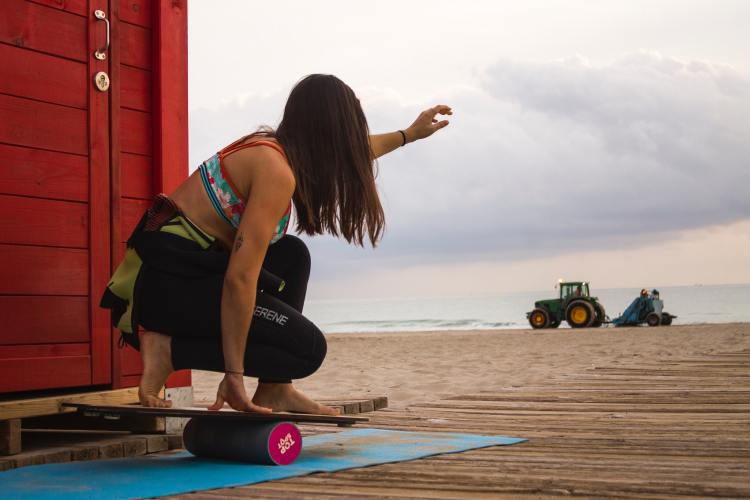
The goal is to be able to have a controlled start from a stop. You can do this from a sitting or standing position, but we are going to focus on a standing position here. Once you get good at this, try to hold a standing position for a few seconds before pulling away.
Start with the bike turned off and located on a flat horizontal surface. Push yourself up and stand on both pegs. Initially you will stay on it for less a second before you start losing your balance. Catch yourself on the side to which you end up leaning, and do not wait for the bike to lean a lot. Catch it with your foot, as described in BALANCE – STOPPING. If it leans too far, there is typically no saving it, especially while beginning to learn. Depending on your physical fitness, do from 5 to 15 attempts. Remember to breathe and look at a far away object, not at the ground right in front of you. After doing an initial set, walk away for a few minutes. Repeat one or two sets. You should not make yourself very tired. This trains your knees and your vestibular system. You can do this every day and after the first week, you should be able to balance on it for at least a second or more. Progress as far as you like. There is no upper limit. The next level will be to have a controlled start going uphill. Then – going downhill.
Prerequisite: Breathing, Looking Ahead, Balance – Stopping.
Homework: every time you leave from a quiet intersection, when you don’t have cars behind, stand on pegs, feel the balance before pulling away.
- Slow Race

This is a skill that would help improve the quality of your riding.Prerequisites – Stopping with one foot, balancing a standing bike with one feet on the ground, breathing, look ahead.
Homework – Check out my YouTube video. Practice in a safe environment first. Don’t expect to master this over one or two sessions on a parking lot. This takes time and patience. Invite your friends to do such type of a race in an empty parking lot. Have fun. When you take this skill to the street, make sure that your surroundings are safe. Double check for that.
- Balance – Stopping with One Foot

We have to stop many times even during a short ride: lights, intersections, yielding to pedestrians…. With a heavy and tall bike, you need to master stopping with one foot on the ground.Prerequisite – balancing a standing bike, looking ahead.
Homework – Start with this video, practice in a safe environment until this feels natural. Only after that proceed to quiet streets. Be mindful of the landscape, plan your stops carefully.
Get new content delivered directly to your inbox.
 LanaOnWheels